Porton Down
Blow OutPorton Down is the highly secure government research establishment to which Joanne Stuart’s team sends a pellet recovered from the Worsley golf course for analysis. In the investigation of the ricin-pellet attacks, it serves as a specialist scientific resource: its examination connects a physical piece of evidence to the poison used, while its work on an antidote brings both the promise and limits of expert intervention into view.
Purpose in the investigation
When the team learns that the recovered pellet may be the means by which a toxic agent was delivered, it is advised to send it directly to Porton Down rather than rely on ordinary forensic services. The recommendation reflects the facility’s particular expertise in identifying an unfamiliar or dangerous substance. Jo arranges a carefully controlled transfer: the pellet is to travel by motorcycle relay from the police boundary with Cheshire to Wiltshire, after she cannot obtain approval for air transport. The evidence is treated as exceptionally valuable because the investigation depends on establishing what it carried.
Porton Down’s involvement takes place amid wider pressure on the investigation. Joanne Stuart’s team is working with limited police resources, while other units focus on preventing a gang conflict and the National Crime Agency is supporting the search for Melissa Walsh. The specialist facility does not replace those investigative tasks; rather, its analysis addresses one narrow but decisive question about the attacks. The distinction between laboratory identification and police inquiry remains important: scientific evidence can clarify the poison, but the team must still establish who prepared and delivered the pellet.
The facility and its security
Jo reaches the Defence Science and Technology Laboratory at 9:25 a.m. after an early start and a late night at Nexus House. The site initially appears less sinister than she had expected, but its perimeter signs warn visitors to keep out, identify Ministry of Defence property, and mark hazardous areas. She has also seen two Ministry of Defence police officers carrying MP7 sub-machine guns. Security is present not as theatrical decoration but as part of the practical setting for work on chemical, biological, radiological, and nuclear defence.
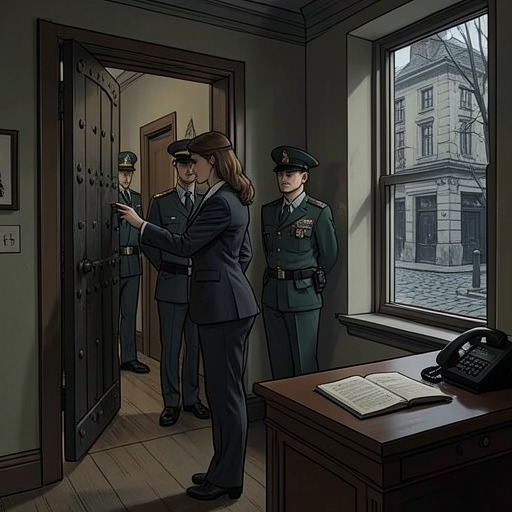
The reception building makes a striking contrast with that protected perimeter. The single-storey structure, built of red brick and glass, looks to Joanne more like the reception centre of a Royal Horticultural Society property than an advanced military research facility. The ordinary appearance does not settle her unease: she is entering a secret establishment whose work concerns serious hazards. After presenting her identification and signing the visitors’ book, she waits in reception, where a drink machine and an offer of coffee coexist with the guarded entrance and restricted institutional world beyond it.
Examination of the pellet
Before the scientific discussion, Joanne signs a document bearing both Ministry of Defence and company logos. The careful, formal process underscores that access and information at the facility are controlled. The scientist then opens the brown envelope and removes two nested transparent evidence bags. The inner bag still carries the original evidence record; its continuity label has been updated at Porton Down, and the bags have been sealed and resealed with forensic tape. The chain of custody is made visible in the handling of the exhibit rather than assumed.
The pellet was already identified by police ballistics experts. Porton Down’s task is different: to determine whether it had been modified to carry a toxic substance and, if so, to identify that substance. This division of expertise shows how the investigation’s conclusion is assembled from separate procedures. The police establish the object’s ballistic identity and preserve it; the specialist laboratory examines its possible toxic function. The visit therefore turns an alarming suspicion into a question that can be tested against the exhibit.
The laboratory’s findings also have immediate consequences beyond the evidence file. After the two attacks, Joanne asks whether a quantity of antidote could be made available in case further victims are discovered. She is told that a batch of twelve antidotes has already been sent by courier to a toxicologist at the Manchester Royal Infirmary, who is registered with the National Poisons Information Service. The supply gives the response a practical medical resource, but it does not offer a general or unlimited remedy.
Limits of scientific intervention
The antidote’s usefulness is sharply constrained by time. The scientist explains that its efficacy is, in most cases, limited to the first twenty-four hours after exposure. After more than four hours following a lethal dose, the effects are generally irremediable, even though death may take as long as five days. The delayed course of poisoning can therefore create a dangerous gap between exposure and visible consequence: the passage of days does not mean that treatment remains equally possible throughout them.
Jo is angry that the antidote information had been withheld until she asked, perceiving the exchange as an inappropriate contest while people have already died. At the same time, she recognises that the scientist had anticipated the request and arranged the shipment in advance. That mixed response captures Porton Down’s place in the story: specialist foresight can make a concrete difference, but the value of that preparation is bounded by the narrow treatment window. The facility provides essential knowledge and resources; it cannot undo the attacks or guarantee rescue for anyone exposed too late.